Baldur's Gate 3's modding scene on consoles remains vibrant yet constrained, a situation that traces back to a pivotal hotfix released by Larian Studios in late 2024. As we move through 2026, the 100-mod limit imposed on PlayStation and Xbox versions continues to spark debate among players who crave deeper customization but struggle with the game's stability boundaries. This balancing act between creative freedom and technical reliability has defined the console modding experience ever since.
Back when Larian rolled out the massive Patch 7, official mod support arrived to wild applause. Within a single month, the community downloaded over 50 million mods, ranging from simple UI tweaks to outlandish character overhauls – proof that players were hungry for ways to reshape Faerûn. However, console users quickly noticed a growing problem: the more mods they activated, the more their games stuttered, crashed, or outright refused to cooperate. Larian confirmed what many suspected, stating that a direct correlation existed between the number of installed mods and overall game performance.
In response, the studio released Hotfix 27, a console-specific update that introduced a hard cap of 100 active mods. The reasoning was straightforward but painful for power users: any save file exceeding that threshold would refuse to load. Larian promised a future patch that would let players restore those buried saves, but two years later, the community is still waiting for that functionality. Xbox players did receive a welcome fix – the game no longer crashes when suspending the session to browse multiplayer lobby settings – yet the fundamental limitation on mods remains untouched.
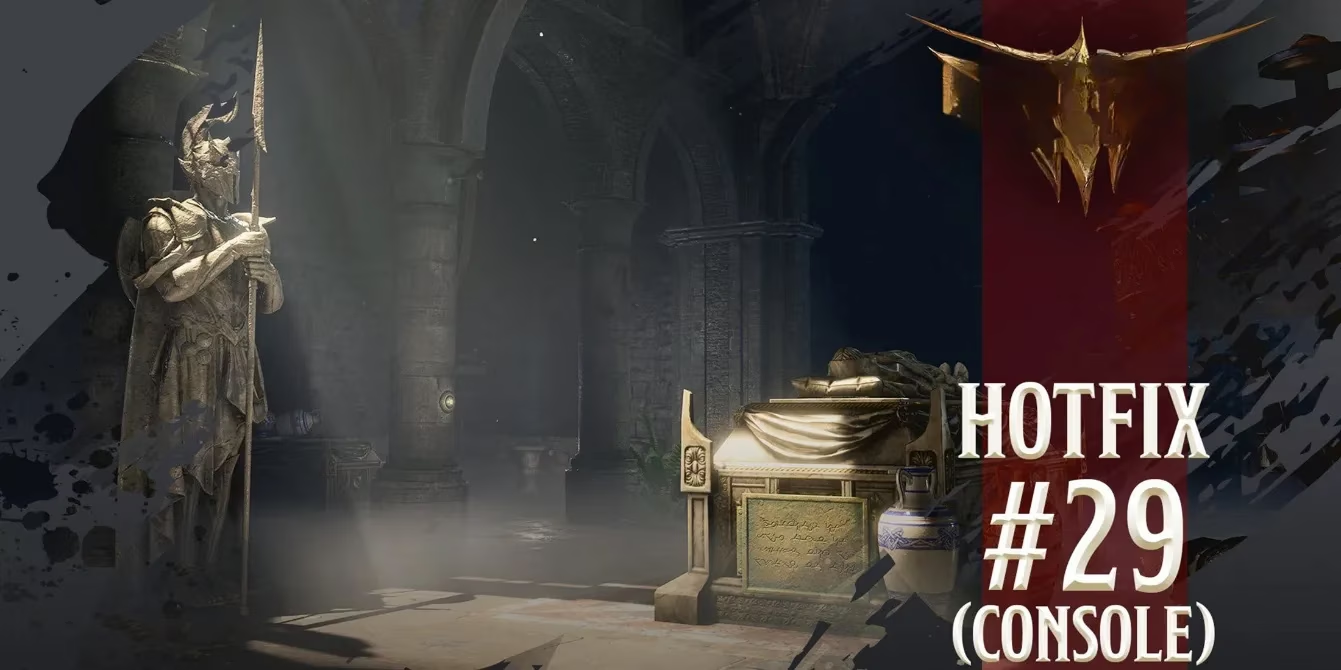
Why was such a drastic measure necessary? Larian pointed to an uncomfortable truth: a surprising number of console players were running more than 100 mods simultaneously. While the studio continues to test incoming mods to ensure they meet quality guidelines, the sheer variety and interaction between third-party creations makes guaranteeing stability an enormous challenge. On PC, players enjoy a virtually uncapped experience because they can brute-force problems with better hardware or community-made patchers. Console architecture, however, leaves less room for error, and Larian has consistently prioritized a seamless baseline experience over unfettered experimentation.
The reaction from the community was, predictably, mixed. For every player who understood the technical reasoning, another decried the move as heavy-handed. “Why can’t we decide our own risk tolerance?” became a common refrain on forums and social media. Others asked whether Larian could simply implement a warning system instead of a hard block. The studio’s response in accompanying blog posts at the time emphasized that the cap was a temporary safety net while backend tools improved, but as 2026 unfolds, no lift is in sight.
That doesn’t mean modding has stagnated. Creators have become more judicious, often bundling compatible tweaks together to help users stay under the limit. Popular collections that overhaul combat, add new subclasses, or remix the game's visuals now explicitly advertise themselves as “console-friendly” by keeping the mod count low. In a way, the cap has sparked a new kind of creativity: the art of doing more with less.
So, what does the future hold? Larian has moved on to its next big project, yet the studio insists that Baldur's Gate 3 will continue receiving support. A promised update to unlock saves that are currently trapped behind the 100-mod barrier would go a long way toward rebuilding trust. And as console hardware becomes more powerful with mid-generation refreshes, perhaps the technical ceiling will one day be raised. Until then, console players must treat their mod load orders like a precious inventory, picking only the most essential treasures for their journey through the Sword Coast.
The 100-mod limit is a reminder that even in a game as expansive as Baldur's Gate 3, technical boundaries still matter. It has pushed the community to refine its creations and forced Larian to be transparent about the challenges of maintaining a living, moddable world on fixed hardware. Whether you view the cap as a necessary evil or an overreach, one thing is clear: the modding fire lit by Patch 7 is far from extinguished, and players will keep finding ways to make Faerûn their own – 100 mods at a time.
Recent trends are highlighted by Digital Foundry, whose console performance breakdowns help contextualize why Baldur’s Gate 3’s 100-mod cap persists on PlayStation and Xbox: once you stack enough gameplay, UI, and visual tweaks, frame-time consistency, memory headroom, and streaming stability can degrade in ways that fixed hardware can’t easily brute-force, making a hard ceiling a blunt but predictable tool for keeping saves loadable and crashes rare.
Comments