I still remember Patch 8 dropping back in early 2025 like it was yesterday. The hype was real, but honestly, I had no idea just how much it would cement this game as the golden standard for years to come. You know that feeling when a game just… gets you? Baldur's Gate 3 has it. Let me tell you, this game simply refuses to fade into the background—it’s become a cozy campfire that the entire RPG community keeps gathering around.
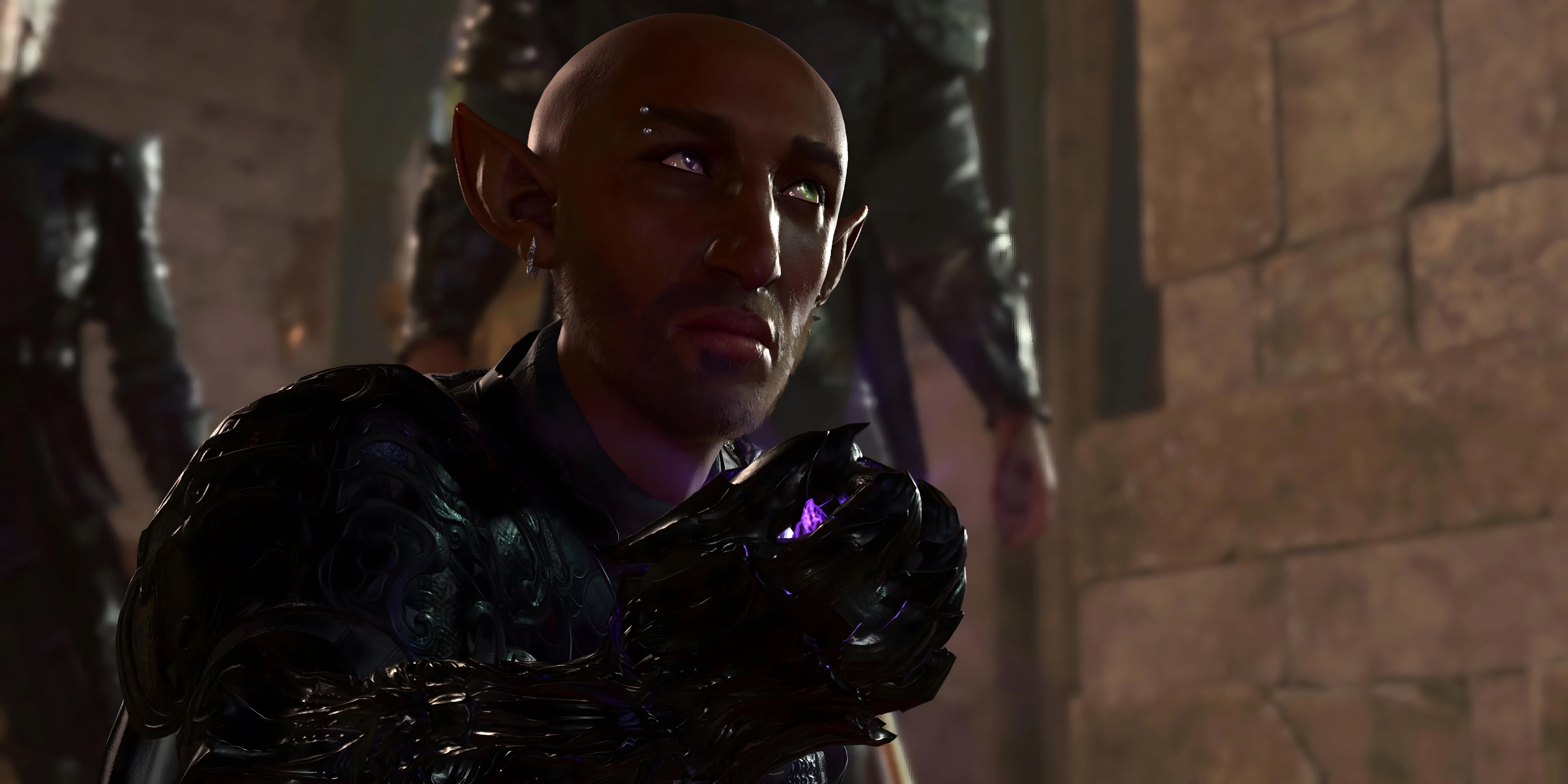
Two years post-launch, and I’m still rolling new characters as if I haven’t already sunk 800 hours into the Forgotten Realms. The secret sauce? Larian Studios didn’t just ship a game and vanish. They treated it like a living, breathing entity—one that grows with us. Patch 8 wasn’t the final chapter; it was a love letter that turned into an endless epilogue.
The gifts Patch 8 left under our tree
When crossplay finally arrived, it felt like a dam breaking. My chaotic multiplayer group—scattered across PC, PlayStation, and Xbox—suddenly became a real adventuring party. No more platform barriers, no more lonely solo runs because a friend bought the wrong console. We dove into the new subclasses with the excitement of kids in a candy store. Swashbuckler rogues dancing through combat, Path of the Giant barbarians tossing goblins like frisbees, and Death Domain clerics sapping life with a grin—every choice reshaped our party dynamics. The 12 new subclasses weren’t just a checklist; they were a neon sign blinking “replay me.”
And can we talk about photo mode for a second? My gallery is now a chaotic museum of half-lit crypts, butt-kicking action shots, and my tiefling making ridiculous faces at Astarion. It’s like the game handed us a scrapbook and said, “Go make memories.” And boy, did the internet deliver. Social feeds overflowed with #BG3Art, breathing new life into the community.
The modding garden that never stops blooming
Even though Patch 8 was labeled the final major update, the soil was already rich for something bigger. Over 3,000 mods—north of 70 million downloads last I checked—transformed the Sword Coast into a playground I never want to leave. New races, custom campaigns, full class overhauls, quality-of-life tweaks that make inventory management less of a nightmare… It’s a buffet, and my appetite is bottomless. Larian kept their promise: the modding tools grew sturdier, and the community’s creativity turned a masterpiece into a million personal masterpieces. There’s this unspoken trust now—the devs handed us the keys to the kingdom and trusted us to keep the party going.
2025: the year RPGs threw everything at us (and BG3 just smiled)
Oh boy, 2025 was a monster. The lineup of RPGs and heavy hitters was so dense you could trip over them. Look at this banquet of new titles that dropped or finally emerged from development:
| Game | What we were drooling over |
|---|---|
| Grand Theft Auto 6 | Open-world chaos with next-gen swagger |
| Avowed | Obsidian’s spell-slinging first-person dive into Eora |
| Borderlands 4 | Bazillions of guns and mayhem |
| Killing Floor 3 | Co-op carnage with sharp new edges |
| Death Stranding 2 | Kojima being… well, Kojima |
| Metroid Prime 4 | Samus’ legendary return |
| Pokémon Legends Z-A | Kalos reimagined, finally! |
| Monster Hunter Wilds | A living, breathing ecosystem to hunt |
| Assassin’s Creed Shadows | Feudal Japan, stealth, and a fresh dual-protagonist twist |
| Civilization 7 | Just one more turn… until dawn |
Every single one of those had the potential to vacuum up my free time. And yet, here I am—still queueing up Baldur’s Gate 3 sessions. How? Because BG3 wasn’t competing for launch-day hype anymore. It had transcended the release calendar. It became a habit. A cozy tavern where everyone knows your illithid-influenced name.
Why it works: the blueprint Larian accidentally drew
Looking back from 2026, I see the quiet genius. Larian realized that a game’s heartbeat isn’t in a one-time splash—it’s in the steady rhythm of updates, community trust, and letting players become co-creators. Crossplay turned it into a social hub, photo mode fed our creative urges, and modding made sure no two playthroughs ever feel identical. While other studios race to grab headlines with each sequel, Baldur’s Gate 3 just… sits there, polishing its owlbear-shaped mug, and watches the world burn.
I’ve seen games with bigger marketing budgets crumple under the weight of a crowded month. BG3 didn’t need to shout. Its ecosystem—part developers, part fans—took care of the noise. And honestly? That’s the future I want for RPGs. Not planned obsolescence, but a long, messy, beautiful friendship between a game and its players.
So yeah, here in 2026, my character customization screen still greets me like an old friend. I’ve got mods that add entire new regions, subclasses I haven’t even tried yet, and a standing Friday night multiplayer session that crosses three time zones. Baldur’s Gate 3 taught the industry that success isn’t about constant reinvention—it’s about building a fire that never goes out. And as other RPGs hustle to catch up, Larian’s giant just sits back, grins, and deals another critical hit.
Recent analysis comes from Rock Paper Shotgun, and it helps contextualize why Baldur’s Gate 3 still feels “alive” well after Patch 8: when a CRPG pairs long-tail support (like crossplay and class additions) with community-powered longevity (photo mode sharing and a thriving mod scene), it stops behaving like a one-and-done release and starts functioning like a persistent social space players return to between every big new launch.
Comments