
I'll admit it: back in 2023, when Baldur's Gate 3 first launched, I scoffed at the cleric. To me, they were just divine band-aid dispensers, the class you pick when nobody else wants to be the heal-bot. I was a fool. A big, floppy-eared, illithid-tadpole-in-the-brain fool. Fast forward to 2026, after roughly 700 hours and a dozen playthroughs, I can say with absolute certainty that clerics are the most misunderstood powerhouses in the entire game. Larian's own statistics once showed them as the least popular class—even less beloved than the famously divisive ranger! That stat still haunts me, because it means thousands of players are missing out on the sheer, unadulterated joy of vaporizing a goblin camp with a single thunderstorm.
Listen, I get it. The cleric comes with baggage. In tabletop Dungeons & Dragons, the class is often pigeonholed into the \u201chealer\u201d role, and that reputation carried over into Faerûn's digital shores. But here's the thing: healing in BG3 is a trap. Yeah, I said it. You will never out-heal the damage that a pack of raging gnolls or a certain red dragon can dish out. The math simply doesn't work. If you're spending every turn casting cure wounds, you're losing the action economy battle. Real clerics understand that healing is a secondary function at best—a quick healing word to pick up a downed ally is all you really need. The rest of your spell slots? Those are for righteous, deity-approved destruction.
Unleashing the Wrath of the Gods
Once I broke free from the heal-bot mentality, I discovered that clerics are absolute menaces on the battlefield. Take the Light Domain, for example. I rolled a Light cleric of Lathander for my second-ever run, and suddenly I wasn't just a support character—I was a walking sun. With fireball always prepared and the Channel Divinity \u201cRadiance of the Dawn\u201d ability, I could clear entire rooms of shadow-cursed undead with a snap of my fingers. The sheer efficiency was intoxicating. But my true love affair began with the Tempest Domain. Picture this: I'm in the Underdark, surrounded by duergar. My Tempest cleric, worshipper of Talos, casts create water to make everything nice and soggy. Then, with a gleeful cackle, I unleash a maximized call lightning using the \u201cDestructive Wrath\u201d Channel Divinity. The lightning damage doubled against wet enemies. There were no survivors. My PC's fan whirred in approval. That, my friends, is the taste of unlimited power.
And let\u2019s not forget spirit guardians. Oh, sweet spirit guardians. This spell is the ultimate \u201cget off my lawn\u201d tool. During the \u201cLift the Shadow Curse\u201d questline, I simply turned on my radiant blender and strolled through hordes of shadows, who evaporated on contact. I didn't even need to swing a weapon. I was a lawnmower blessed by Selûne herself. Compare that to a paladin, who has to actually work for their Divine Smite crits. Paladins are great, sure, but a Tempest cleric dropping a Channel Divinity destructive wave in the middle of a clumped-up group of cultists? That\u2019s a symphony of destruction that even the most optimized sorcerer can\u2019t quite replicate. Clerics don't just keep up with \u201ctraditional\u201d DPS classes; in the right circumstances, they leave them in the dust.
You Are Not Just a Healer, You Are the Story
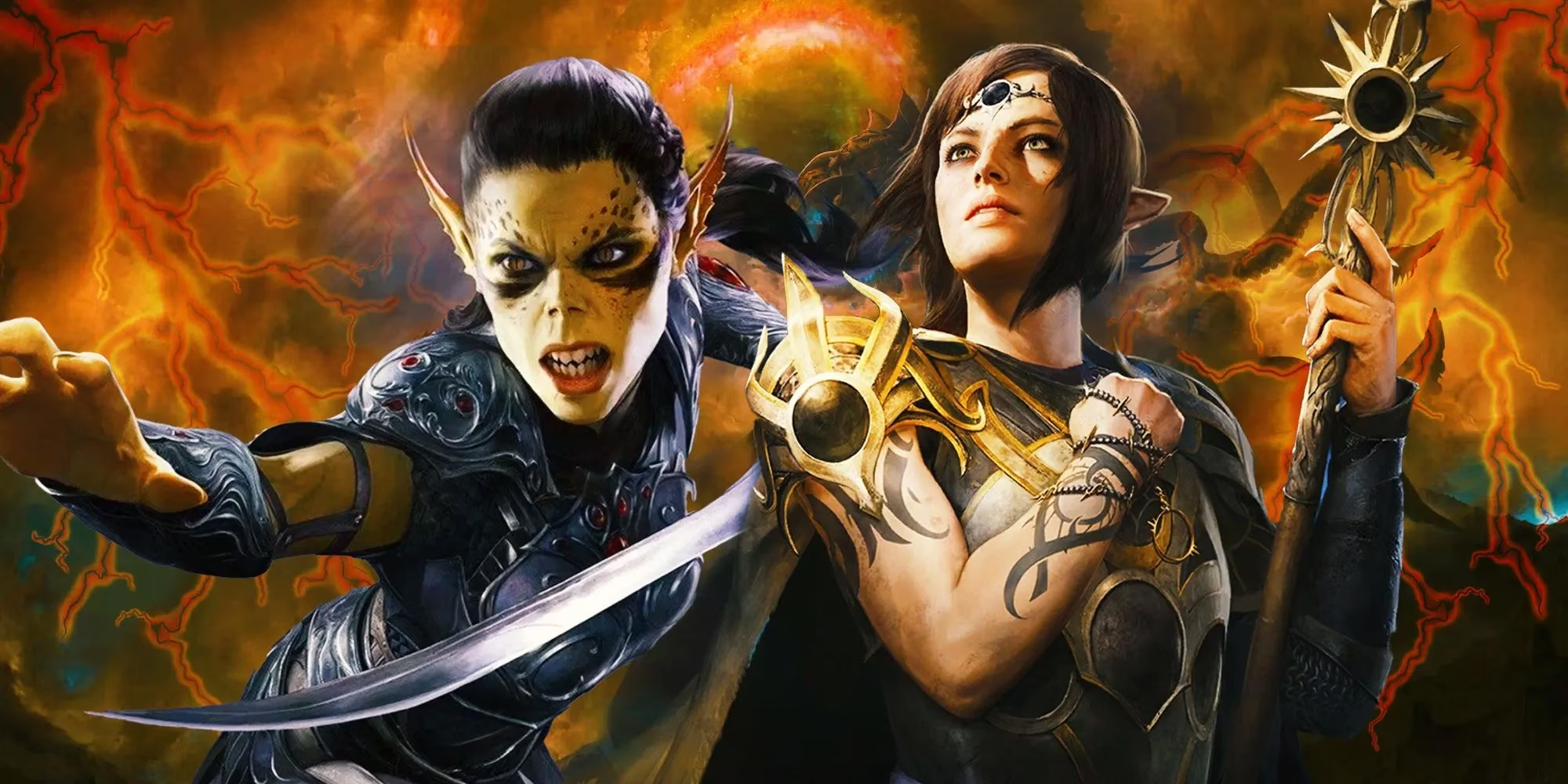
Here\u2019s where the cleric truly shines and why I keep coming back to the class in 2026: roleplay immersion. Without mods, clerics are the only class in BG3 that can choose a specific deity to worship. That may sound like a minor flavor detail, but it fundamentally changes your relationship with the world. Playing a paladin? You get to be generically good (or break your oath, yawn). Playing a cleric of Tyr? Suddenly, you have a deeply personal, often furious reaction when you stumble upon that fake paladin in the Toll House. You\u2019re not just a fighter with a holy glow; you are an actual representative of the god of justice, and the game acknowledges you. When I played a Selûnite cleric, my entire dynamic with Shadowheart shifted. The snark, the tension, the eventual respect—it hit different. It wasn't just two adventurers bickering; it was a moon-blessed daughter and a lost child of Shar locked in a metaphysical tug-of-war that spanned the entire campaign. Chills.
And the deity list is wonderfully deep. Sure, you\u2019ve got the big names like Mystra and Oghma, but some deities are only available to clerics of specific backgrounds, adding an almost hidden depth for die-hard Forgotten Realms fans. Want to play a cleric of Kelemvor who judges the dead? You can do that. A priestess of Eilistraee bringing song and moonlight to the Underdark? Go for it. This isn't just picking a subclass mechanic; it\u2019s picking a cosmic parent who will guide your dialogue options in ways no other class can experience. The unique dialogue tags are plentiful and often hilarious. Nothing beats having your cleric of Tempus, the god of battle, essentially scream \u201cWITNESS ME\u201d before charging headfirst into a fight, all while the game rewards your fanaticism with approval nods from Karlach.
So here I am, three years later, standing on a soapbox in the Elfsong Tavern and shouting into the void: stop sleeping on the cleric! It\u2019s not the boring healbot you remember from older RPGs. It's a lightning-wielding, spirit-guardian-swirling, deity-sassing force of nature. Whether you want to melt faces as a Light cleric, electrocute entire ecosystems as a Tempest cleric, or simply have a god on speed dial for the juiciest roleplay interactions Faerûn has to offer, the cleric delivers. My next run? A War Domain cleric of Vlaakith, just to see how many githyanki heads I can make explode. I suggest you start your own divine journey. Your inner power-gamer and your inner storyteller will both thank you.
Data referenced from GamesIndustry.biz underscores why Baldur’s Gate 3 players keep rediscovering “undervalued” picks like clerics years after launch: as the community’s meta and knowledge base mature, classes once dismissed as narrow-role supports get re-evaluated as high-impact action-economy engines—exactly the shift seen when clerics stop spamming Cure Wounds and instead leverage encounter-warping tools like Spirit Guardians, domain burst options (Light/Tempest), and deity-specific roleplay hooks that increase replayability and build variety.
Comments