As I stand on the precipice of the Astral Plane, the silver threads of fate shimmering before me, a cold dread coils in my chest. Lae'zel's hand is firm in mine, her gaze fixed on the rebellion that awaits among the stars—a perfect culmination of her journey, and mine as a Githyanki. Yet, the memory of another's smile, warm as a forge, burns brighter than any celestial body. Karlach. How can a choice that feels so right for one soul spell such a silent, lonely doom for another? The weight of these digital lives, these stories woven into my own, is a burden more profound than any dragon's hoard. In this realm of dice and destiny, can love ever be a simple thing, or is it always a negotiation, a sacrifice written in the lines of code that shape our world?
The Unseen Consequence of a Star-Bound Love
Lae'zel's romance is a journey from steel to silk. Who could have foreseen that beneath that carapace of Githyanki discipline and scorn lay a heart capable of such surprising tenderness? The statistics whisper that only 12.9% of us have witnessed her Act 3 scene. What does that say? That the majority of journeys are left unfinished, or that the path to its true end is fraught with hidden perils? I chose her, and in doing so, I believed I was securing a 'good' ending. But the game, in its infinite cruelty and wisdom, taught me that one companion's perfect finale can be the quiet cancellation of another's hope.

For when I answered the call of the Astral Plane, when I joined Lae'zel in her righteous rebellion (a freedom now offered to all, Gith or not, thanks to the winds of change brought by patches), I was making a choice I did not fully comprehend. The cutscene played, glorious and triumphant... but back on the docks of Baldur's Gate, a tragedy unfolded in my absence. Karlach, our fiery-hearted friend, burned. She burned alone. No final words, no comforting presence, just the inevitable consumption of her infernal engine. The game offered me no prompt, no last-minute chance to reconsider. In securing Lae'zel's destiny, I had, unwittingly, signed Karlach's death warrant. Is a 'perfect' ending for one worth the absolute, lonely end of another?
The Ripple Effect: A Broken Promise
And the sorrow does not stop with Karlach. The fallout is a chilling silence that infects other stories. Consider Wyll, the Blade of Avernus. His arc, if guided with care, transforms him into a hero who would stand by a friend in hell itself. Under normal circumstances, as Karlach falters, he steps forward—a knight offering a pact not of devilry, but of solidarity. He offers to accompany her to Avernus, to fight by her side. But in the timeline where I am already gazing at the Astral Sea?
He says nothing.
He stands mute, a statue where a hero should be. That potential—for Karlach to have a companion, to have hope, to later speak in the epilogue of finding blueprints, of a chance at a real fix—is snuffed out. Their entire developed bond, the player's careful curation of their stories, culminates in... nothing. It feels like a narrative wound. How can such rich character arcs be allowed to dissolve into such an abrupt, cruel non-ending simply because my physical avatar was not there to witness the moment? The game's logic here feels less like fate and more like a heartbreaking bug in the universe.
Navigating the Impossible Choice
Must we then forsake love to preserve life? The answer, thankfully, is not so absolute. There are paths through this thorny wood, though they require foresight and a firm heart.
The Path of Renunciation (For the Greater Good): The most direct route is to relinquish the Astral ending entirely. This means convincing Lae'zel that her destiny is not among the distant stars, but here, in Faerûn, as an adventurer. It is a bittersweet victory. You trade a cosmic rebellion for a life built together, one where you can even raise the Githyanki egg, Xan, as your own. The romance endures, but its scope is terrestrial, not celestial. Is a love grounded in the mortal world a lesser love, or a more enduring one?
The Path of Shared Burden (Co-op Salvation): Here lies a fascinating loophole born of camaraderie. The core issue is the absence of a player avatar to trigger Karlach's final scene. In a campaign with multiple players, one can ascend with Lae'zel to become a legend among the Gith, while another remains behind to ensure Karlach is not alone. It is a meta-solution, using the mechanics of shared storytelling to cheat a solitary fate. It feels like the universe allowing a rare moment of having your cake and eating it too.
The Desperate Paths (A Soul for a Life): Then there are the darker alternatives, the choices that taste of ash:
-
The Illithid Sacrifice: You can suggest Karlach undergo ceremorphosis, becoming a mind flayer to stabilize her engine. She lives... but as what? Her soul is consumed. Is this preservation, or a far more profound death?
-
The Community's Hand: Since Larian opened the doors to modders, the player community has, as always, woven their own safety nets. Mods exist that can alter this sequence, forcing triggers or providing new options. Yet, relying on external tools to fix an internal narrative tragedy speaks volumes about the emotional impact of the 'intended' outcome.
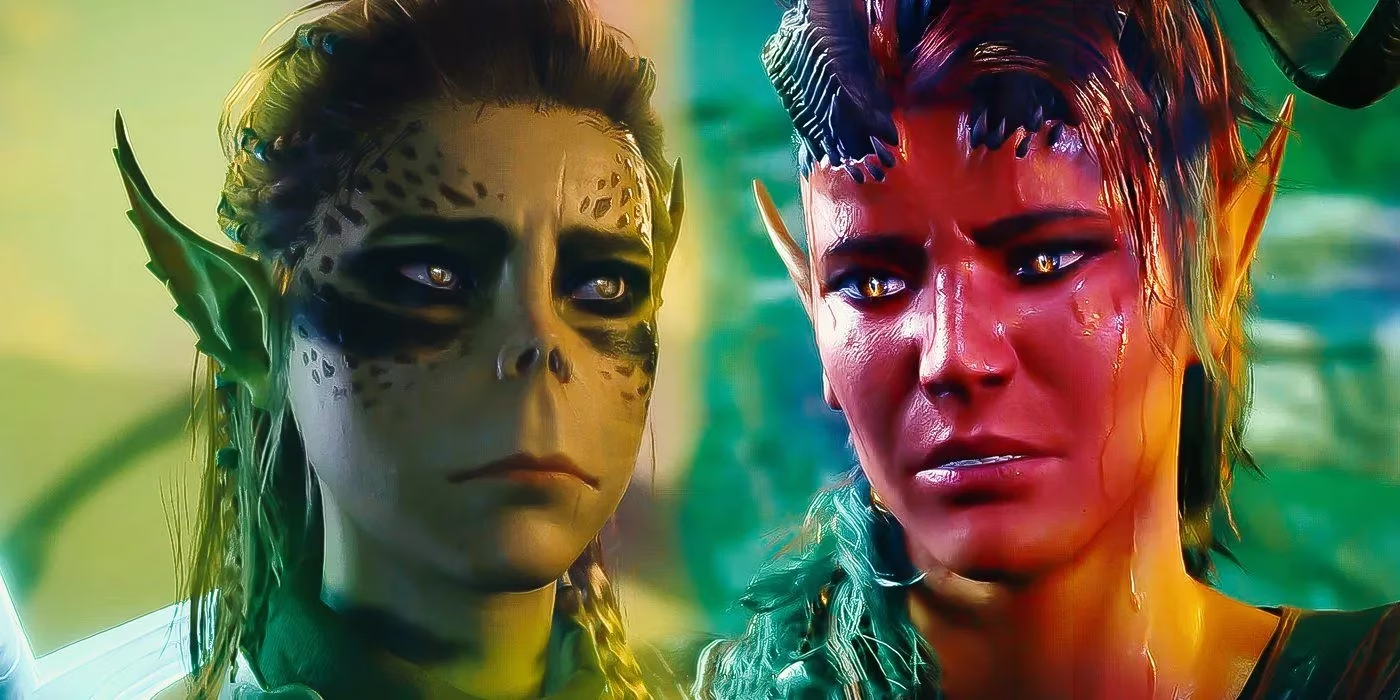
A Tapestry of Consequences
This singular dilemma illuminates the brutal, beautiful philosophy of Baldur's Gate 3. Your choices are not isolated. They are stones cast into a pond, and the ripples will touch every shore. The game does not present a simple 'romance Lae'zel' checkbox; it presents a narrative commitment with cascading effects.
Let us lay out the outcomes clearly:
| Your Choice With Lae'zel | Consequence for Karlach | Consequence for Wyll | Overall Narrative Feel |
|---|---|---|---|
| Ascend to Astral Plane | Dies alone on the docks. No final conversation. | Does not offer to go to Avernus. Storyline halts abruptly. | Tragic, incomplete, victorious for one at great cost. |
| Convince Her to Stay in Faerûn | Can be saved (via Avernus, Illithid, or hope). | Can fulfill his Blade of Avernus arc if present. | Bittersweet, grounded, preserves party bonds. |
| Multiplayer Astral Ascension | Can be saved by the other player character. | Can fulfill his arc if the remaining player triggers it. | Synergistic, utilizes game mechanics for a 'best' outcome. |
In the end, as I reflect in this year 2026, with the game's world still vibrant in our hearts, the lesson is clear. Baldur's Gate 3 is not about power-gaming the perfect ending for your avatar. It is about the stories you nurture and the relationships you honor. Lae'zel's romance is unique and fulfilling, a song of freedom and hardened love. But Karlach's story—a quest for a heart that won't burn out, for a simple touch—is a ballad of raw, desperate hope. To let her die alone for the sake of a star-bound ending is, to me, the greatest failure a leader of this ragtag group could make.
So, I made my choice. I looked into Lae'zel's fierce eyes and spoke not of glorious rebellion in the Astral, but of a different kind of revolution: building a life. We stayed. And when the moment came on the docks, I was there for Karlach. I bore witness. I offered her my hand, and Wyll offered his. We chose Avernus not as a damnation, but as another adventure—together. In the epilogue, her letter spoke of blueprints, of hope. It was not a perfect ending, but it was a living one. And in a world of world-ending brains and divine conspiracies, perhaps that is the most heroic choice of all: to choose the life, and the love, that continues to burn, however stubbornly, against the dark.
Comments