The Underdark holds its secrets close, a silent vault of forgotten histories and whispered legacies. Among its most poignant echoes is the story of Lenore DeHurst, a cleric of Mystra whose presence in my journey through Baldur's Gate 3 was felt not through flesh and voice, but through the lingering scent of ink on parchment and the spectral warmth left in the stones of her arcane tower. She was a ghost in the machine of fate, her absence weaving a more compelling narrative than any direct confrontation could have. Her story is a delicate, half-finished tapestry, its threads fraying into the void, leaving me to trace their paths with the fingertips of my imagination.
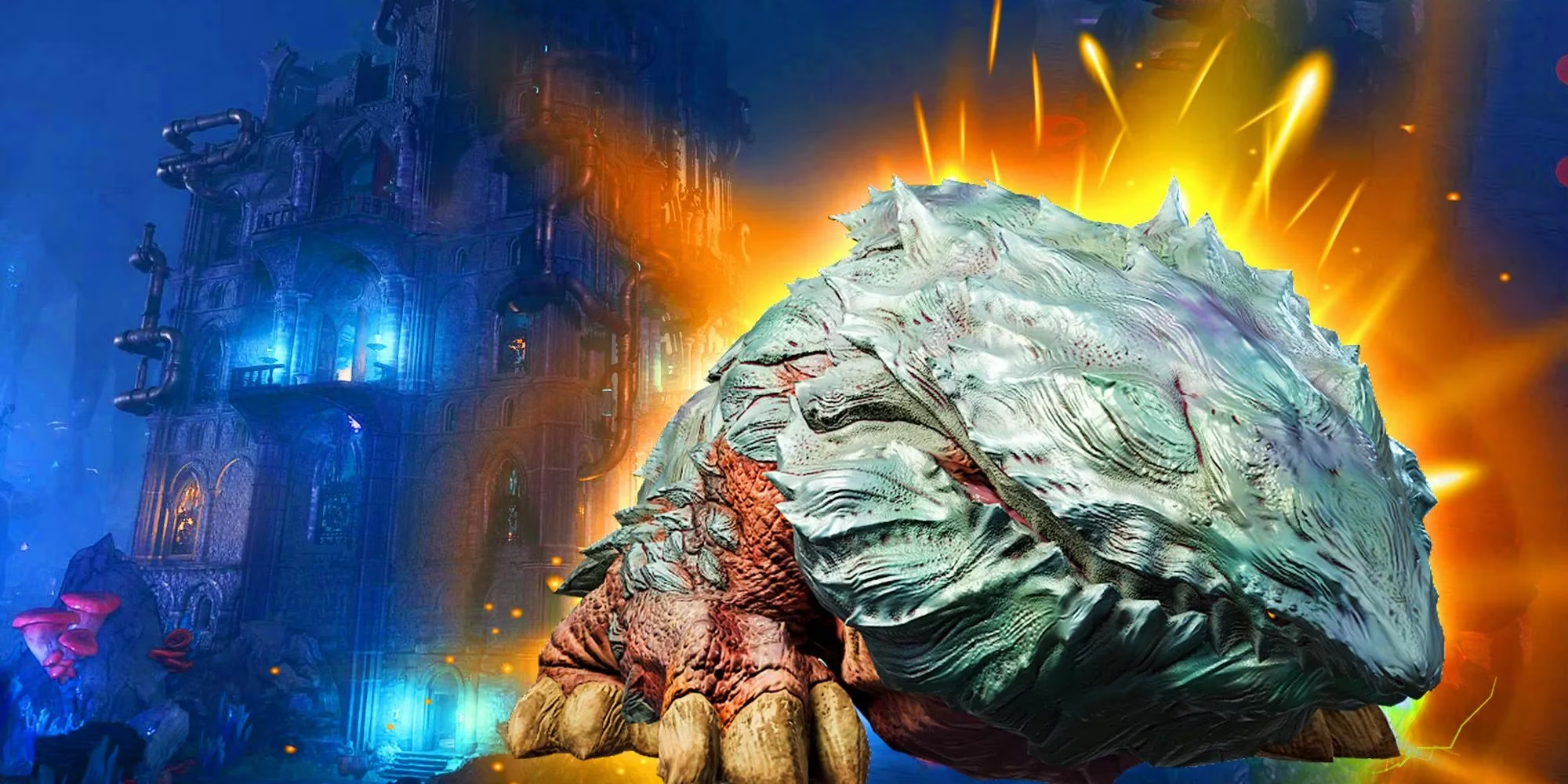
Her home, that solitary spire amidst the fungal forests and bioluminescent gloom, was a museum of a life interrupted. Every book left open, every enchanted bauble humming with latent power, spoke of a mind that danced on the edge of cosmic understanding. Her research into the Sussur blooms, those anti-magic anomalies, was like a composer becoming obsessed with silence—not as an absence, but as a substance to be shaped. Yet, the most prominent relic of her life was not a book or a bloom, but a living, breathing catastrophe: her pet Bulette. This creature, a land-shark of terrifying maw and armored plates, patrolled the grounds with a loyalty that felt like a gravitational anomaly, a force of nature inexplicably tethered to a single point of light. The popular theory, born in the game's early whispers, was a grim one: that Lenore's scholarly ambition had been her end, that she had been consumed by the very beast she sought to tame. The evidence was a chilling piece of logic—a  Slippery Chain Shirt, an item echoing her craftsmanship, found within the Bulette's gullet. It was a story that fit too neatly, a cautionary fable about hubris.
But stories, like reality, are subject to revision. In the world as it stands in 2026, that narrative thread has been snipped. The shirt now rests in a chest, a curator's item rather than a grim digestif. In its place within the beast lies the  Bloodguzzler Garb, an artifact utterly alien to Lenore's elegant, arcane aesthetic. This retcon was no accident; it was the silent turning of a page, an authorial decision that lifted the shadow of a simple, brutal death from her character. The Bulette's enduring, protective vigil around her tower argues against the theory of betrayal. Its presence felt less like a guard dog and more like a living sundial, casting the long, patient shadow of waiting for a dawn that never arrives.
So, if not a meal for her pet, where did the weaver of this silent symphony go? The answer, I believe, lies not in the depths of the earth, but in the spaces between the stars. In the sorcerous vaults beneath Ramazith's Tower, I found the most vital clue: a note, years old, penned by Lenore to the wizard Lorroakan. In it, she speaks with the feverish curiosity of a cartographer finding a blank space on the map that shouldn't exist. She describes a visit from a "strange extraplanar individual," her words tinged with the awe of one who has seen a crack in the firmament. This was no mere academic interest; it was the spark of an obsession. Her studies of the Sussur—localized null zones of magic—could have been mere practice, preliminary sketches for understanding the fundamental laws of other realities. To think she trained a Bulette, a creature of pure, violent instinct, speaks to a mind that saw patterns and connections invisible to others. Perhaps she saw its loyalty not as animalistic, but as a pure, planar constant—a force she could rely on across the shifting tides of existence.
Her partner, Yrre, searched Faerûn in vain. How could he not? We look for lost things where we last saw them. But Lenore's gaze had turned outward. The theory that she stepped through a planar rift, chasing the mystery of that extraplanar visitor, feels not just plausible, but poetically inevitable. Her disappearance was not a tragedy; it was a graduation. The tower, the Bulette, the notes—they are not the scene of a crime, but the shed skin of a soul that outgrew its worldly shell. Her fate is a song sung in a key only the cosmos can hear, its melody carried on the solar winds between the spheres. The Bulette guards an empty nest, not a tomb, waiting for a return that may never come, or perhaps for a sign that its friend succeeded in her ultimate experiment.
As I stand in her silent study in this current age, the mystery of Lenore DeHurst feels more alive than ever. Larian Studios, with their history of weaving deep lore across their titles, has planted a seed with incredible potential. Her story is a perfect, open-ended thread. Will we hear her name whispered in a future title, a veteran planar traveler offering cryptic wisdom? Could she be a power in her own right on some distant plane of existence? The clues left for us—the retconned armor, the revelatory note, the loyal beast—paint a picture not of an end, but of a magnificent, terrifying beginning. Lenore did not drop off the face of Faerûn. She simply found a map to a place where faces, and maps themselves, are rendered obsolete. And in that boundless elsewhere, I like to imagine her still studying, still seeking, her faith in Mystra now encompassing the infinite weave of the multiverse itself.
Comments