I still remember the exact moment I realized Baldur's Gate 3 wasn't just a hit—it was a cosmic event. Not when the mind flayer ship tore through Avernus, not when I first reshaped a companion's entire worldview with a dialogue choice, but when a complete stranger on a train saw my laptop screen and whispered, "Is that the bear scene?" That moment crystallized something strange and wonderful: Larian's masterpiece had done the impossible. It turned a turn-based CRPG adaptation of a 50-year-old tabletop rule set into water-cooler conversation, a cultural touchstone that felt as immediate as any blockbuster shooter. Now, in 2026, as I sit amid a landscape forever altered by that game, I can't help but fixate on a name that has been quietly biding its time in the shadows: Dark Alliance.
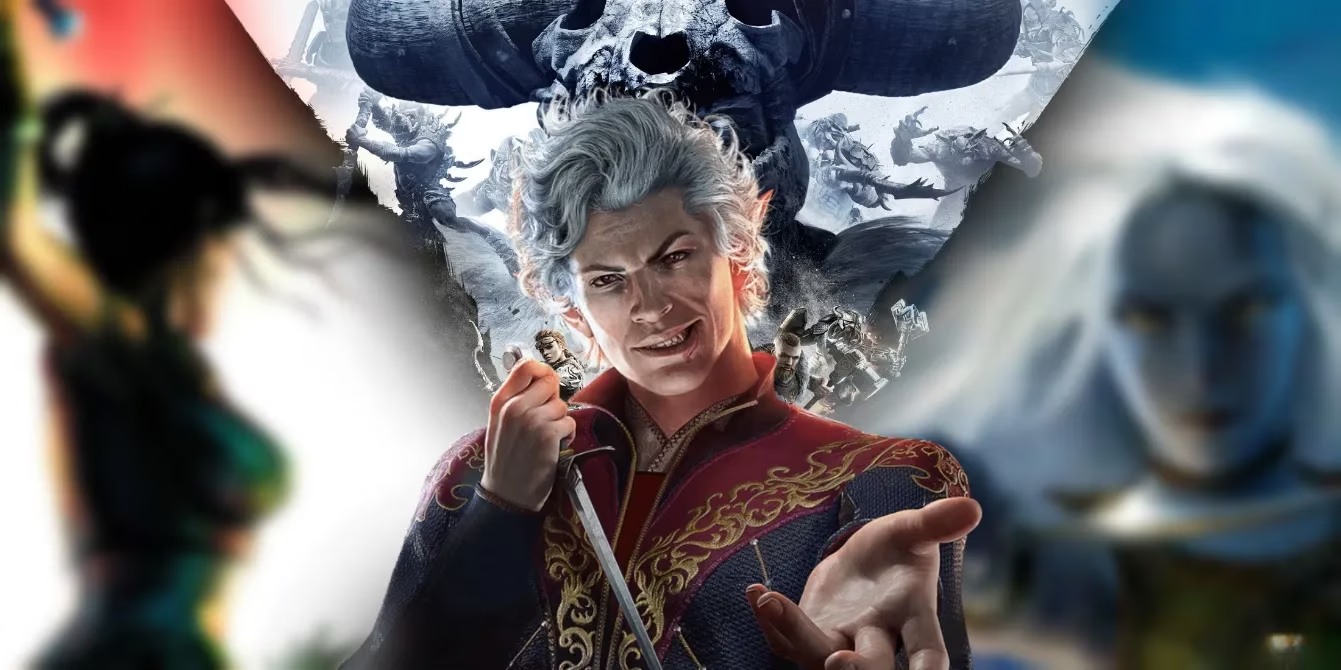
The original Baldur's Gate: Dark Alliance titles, released in the early 2000s, were never quite the main event. They were the action-oriented cousins to BioWare's cerebral epics—isometric ARPGs that let you hack through the Spine of the World or the depths of the Mercenary Guild without needing a manual the size of a grimoire. Yet they had a soul. Beneath the dated polygons and the clunky controls lay a genuine reverence for the Forgotten Realms. The way a flame arrow illuminated a dark tomb, the sense of dread as a displacer beast uncloaked at the edge of your screen—these games compressed the grand lore into digestible, cooperative joy. They were like well-worn vinyl records: scratchy but filled with a warmth that modern digital productions sometimes miss.
The 2021 revival, Dungeons & Dragons: Dark Alliance, was supposed to be the triumphant return. Instead, it landed with the grace of a gelatinous cube dropped from an airship. I played it, hoping to walk the tundra as Drizzt Do'Urden with friends, only to find a hollow shell. The third-person combat felt repetitive and weightless, as if we were slapping enemies with foam swords. The AI was about as sharp as a rusted dagger, and the complete absence of a playable caster class stood as a baffling omission—imagine staging a Dungeons & Dragons adventure with half the rulebook torn out. That game was a key trying to open a lock while facing the wrong direction, and it snapped in the effort. It failed not because the concept was bad, but because it mistook simplification for accessibility, stripping the flesh off the bones until only a pile of unremarkable mechanics remained.
Now, however, Baldur's Gate 3 has handed the entire industry a new blueprint. It taught us that depth and mainstream appeal are not enemies; they can be dance partners. What if a new Dark Alliance absorbed that lesson? I picture a game that doesn't shy away from the loaded dice of D&D rules but translates them into real-time action with a cinematic flair. Picture an isometric view that can seamlessly swoop into a close third-person camera—just as BG3 does—so you can admire the frost-glazed beard of your dwarf berserker before zooming out to flank a group of verbeeg. The original Dark Alliance games were already masters of atmosphere, but imagine that atmosphere rebuilt with modern lighting, volumetric mists creeping over Icewind Dale, and dynamic weather that actually changes how combat feels. You could smell the snow, and the crunch of it under your boots would echo through the gamepad.
This fresh start could finally give the Companions of the Hall the treatment they deserve. Drizzt's scimitars would flash like twin blizzards, each parry and riposte a precise, physics-driven ballet. Catti-brie's bow could hum with the same strategic tension as a spellcaster's choice of incantation, her arrows carving paths of light or binding foes in webbing. Even Wulfgar's hammer wouldn't just be a heavy object; its impact would send shockwaves that literally reshape the battlefield, collapsing ceilings or cracking frozen lakes under enemies' feet. This isn't wistful dreaming—it's a design challenge that BG3 has already solved for turn-based play. Adapting that philosophy to real-time action is the inevitable next step, like a master chef taking the same exquisite ingredients and preparing a different course.
There's another ghost that needs to be appeased: the ghosts of the past isometric CRPGs set in Icewind Dale. The frigid, unforgiving north is more than a backdrop; it's a character that Dark Alliance could fully explore. The original Icewind Dale games taught us that survival itself can be a narrative, and blending that harsh environmental storytelling with the camaraderie of the Companions of the Hall would feel like unearthing a treasure hoard that was always meant to be found. Drizzt's entire legacy is woven into that landscape, and a modern ARPG could thread both nostalgia and novelty through every flurry of snow.
At this point, the market is no longer a guessing game. BG3 didn't merely sell copies; it seeded an audience that now understands what a rich Dungeons & Dragons adaptation can be. Those millions of players who debated the morality of the Emperor or the fate of Shadowheart are primed for a different flavor of the same universe. A renewed Dark Alliance could be to BG3 what a swift, brutal raven is to an eagle: smaller in scope but just as intelligent, just as lethal. I want to gather my friends, not around a table with character sheets, but online, ready to dive into a world where every goblin ambush feels handcrafted, where the loot tells a story, and where the bond between four heroes isn't just written in dialogue trees but emerges naturally from the chaos of battle.
The seed has been buried long enough. The soil has been tilled by Larian's success. It's 2026, and I'm ready to believe that Dark Alliance can finally sprout into the action-packed, lore-rich co-op experience it was always meant to be—not a shadow of Baldur's Gate, but a distinct and worthy ally standing at its side.
Comments